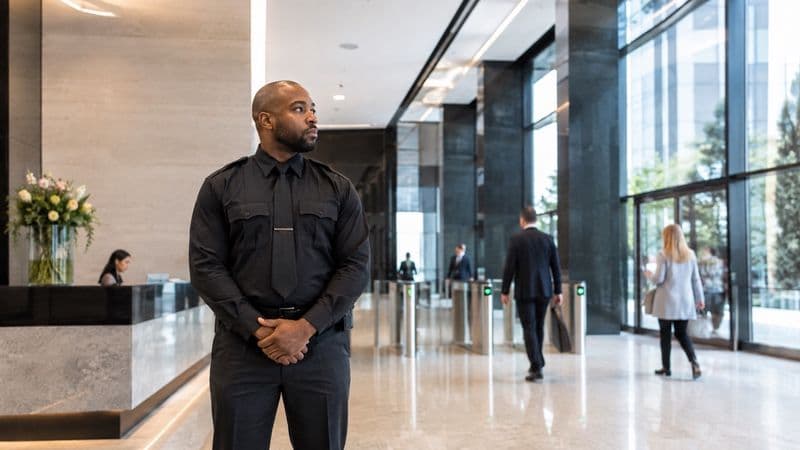

Bank and Financial Institution Security Services That Protect People, Assets, and Access

Banks and financial institutions have very little room for security mistakes.
Customers expect a professional, welcoming environment. Employees need to feel protected. Visitors, vendors, contractors, deliveries, and service providers still need access. At the same time, the property may contain cash-handling areas, restricted offices, sensitive information, ATMs, parking areas, and other spaces that require tighter control. That creates a security environment where visibility, judgment, and consistency matter.
For financial properties using professional security services in New York, the right security team should support daily operations without making customers feel uncomfortable or turning the property into an overly restrictive environment. At Security USA® Inc., we help banks and financial institutions build security programs around controlled access, employee and customer safety, restricted areas, incident response, and the way the property actually operates every day.
Bank security starts with controlled access
A financial institution may look straightforward from the outside, but there are usually several levels of access happening inside the same property. Customers may be welcome in the lobby or service areas, while employees move between offices, teller areas, back rooms, and administrative spaces. Vendors and contractors may need temporary access, and some areas may require additional authorization.
The security plan needs to account for all of that movement without slowing down normal business. That means having clear procedures for customer areas, employee entrances, vendor access, restricted spaces, after-hours entry, and situations that fall outside the normal routine. A good security team should understand who belongs where and know how to respond when access does not match the property’s rules.
Employees need security support they can rely on
Bank employees already have demanding responsibilities. They should not have to handle every suspicious person, access concern, disruptive customer, parking issue, or after-hours security problem on their own. Professional security guard services give employees a clear point of support when something moves beyond normal customer service.
That may be a customer dispute, unusual behavior near an entrance, an unauthorized person in a restricted area, a vendor who cannot be verified, or an incident that needs to be documented and escalated. A good security officer knows when to stay visible, when to observe, when to step in, and when to involve management or emergency services. That judgment matters in financial environments because the security presence has to feel professional without creating unnecessary tension for customers.

Restricted areas need stronger controls
Not every part of a financial institution should be accessible to everyone. Back offices, employee-only areas, cash-handling spaces, records rooms, IT areas, storage rooms, and mechanical spaces may require tighter access procedures. Modern CCTV and access control systems can help support visibility and control around entrances, employee areas, ATMs, parking areas, corridors, and restricted spaces.
But technology should support the security process, not replace it. A camera may show what happened, an access system may control a door, but the security team still needs to understand who should be there, how exceptions are handled, and what happens when something does not look right. That is where clear procedures make the technology useful.
ATM and exterior areas deserve attention
Security does not stop at the lobby. ATMs, parking lots, garages, sidewalks, drive-through areas, employee entrances, and side or rear access points can all create different risks. These areas may become quieter before opening, after business hours, or on weekends. Employees may be arriving or leaving when fewer people are around, while customers may still be using exterior ATMs or parking facilities.
Visibility matters. Lighting, camera placement, patrol coverage, exterior access control, and awareness of suspicious vehicles or loitering should all be considered as part of the overall plan. Customers and employees often form an impression of the property before they ever walk through the front door. If the exterior feels uncontrolled, the rest of the security program may feel weaker too.
Opening and closing procedures matter
The beginning and end of the business day can create different security concerns than normal operating hours. Employees may arrive before customers. Doors may be unlocked in stages. Vendors or maintenance personnel may already be on-site. At closing, customer traffic drops while employees are still working inside and parking areas become quieter.
Security coverage should account for those transitions. The property should have clear expectations for employee arrival, exterior checks, early vendor access, closing procedures, after-hours entry, and what happens when unusual activity is noticed during those quieter periods. The strongest security program does not only work when the bank is busy. It also works when fewer people are around.

Communication and reporting need to be consistent
Financial properties depend on clear communication. Employees should know how to reach security. Security should know who to notify. Management should not have to reconstruct an incident hours later because nobody clearly recorded what happened.
A professional program should establish how incidents are documented, when management is contacted, how shift handoffs are handled, and when law enforcement or emergency services should be involved. As discussed in Why Security Problems Often Start With Poor Communication, small security issues can become larger operational problems when information does not move clearly between the people responsible for the property. In financial environments, documentation and accountability matter just as much as visible security.
Security should fit the financial institution
Not every bank or financial property needs the same security plan. A neighborhood branch does not operate like a large corporate banking office. A financial services firm may have different access concerns than a customer-facing bank. A property with an attached garage or several entrances may require different coverage from a smaller standalone location.
A useful site review should consider:
- customer and employee traffic
- entrances, restricted spaces, and ATMs
- parking and exterior areas
- opening, closing, and after-hours activity
- technology and existing security coverage
- prior incidents and management concerns
The strongest plans are built around how the property actually operates. A generic security program may overlook the areas that matter most.
Why this matters
Financial institutions are expected to feel safe, professional, controlled, and reliable. Customers need confidence. Employees need support. Management needs visibility. Restricted spaces need protection. Access procedures need consistency. Professional security helps bring those pieces together.
The best security teams do not make a bank or financial institution feel intimidating. They help it feel steady, organized, and professionally managed. That is what property managers, ownership groups, employees, and customers should be able to notice every day.